

iAiO Haiti
International Artificial Intelligence Olympiad · 2027 Edition (Vietnam)
Haiti's official national pathway for the International Artificial Intelligence Olympiad (IAIO), supported by IRCAI (International Research Centre on Artificial Intelligence at the Jožef Stefan Institute). The 2027 edition takes place in Vietnam from February 25 to March 2, 2027, challenging secondary-school students across theoretical AI math/algorithms and practical Python modeling.
iaio-official.org, Vietnam, Feb 25 – Mar 2, 2027) and IOAI (ioai-official.org, Singapore, July 4–10, 2027).
Last updated: 23/11/2026 · Official accreditation: Stratiums Technologies / Stratiums Youth Tech Initiative (YTI)
Haiti Launches Its National Selection for IAIO 2027
Following our official accreditation, Stratiums Technologies & YTI are launching a nationwide preselection across all 10 departments of Haiti. Train on Nitro AI Judge: 5 team members will be selected from preselection for intensive training in Jacmel, and 2 of them will represent Haiti at IAIO 2027 in Vietnam.
Contestant Admission Conditions
Every applicant to Haiti's IAIO 2027 nationwide preselection must satisfy all international IAIO rules and national training commitments below:
1. Age Limit (20 or Younger)
Contestants must be 20 years old or younger as of July 1, 2027 (born on or after July 1, 2007). Applicants under 18 require parental or legal guardian consent.
2. Secondary School Student
Must be enrolled full-time in a secondary school (or upper primary) during the 2026–2027 academic year. Students enrolled in a university/tertiary degree program are not eligible.
3. Haiti Representation
Must be a Haitian citizen or a long-term resident schooled in Haiti, and participate in only one country's national selection for IAIO 2027.
4. Python, Math & Nitro AI Judge
Strong motivation in mathematics and Python programming, plus commitment to complete online preselection & practice rounds on judge.nitro-ai.org.
5. Ability to Travel to Jacmel for Training (If Selected)
Candidates from all 10 departments of Haiti may apply and take the initial preselection remotely. From preselection, 5 team members will be retained for intensive training — and if selected among these 5, the student MUST be able to travel to Jacmel (Sud-Est, Haiti). At the end of the training, 2 contestants will be selected for the upcoming IAIO 2027 competition in Vietnam.
Two Complementary Rounds: Scientific & Practical
IAIO is an individual competition with medals awarded based on individual performance and an informal country ranking.
1. Scientific Round
Mathematical and algorithmic problem-solving covering the foundations of machine learning, probability, optimization, AI search, and responsible AI. Answers are typeset and submitted as PDF.
2. Practical Round (Python)
Hands-on AI model development and coding in Python on pre-configured machines, preceded by a practice run so contestants can test the environment.
3. Human-Centred & Ethical AI
Supported by IRCAI (UNESCO Category 2 Centre), IAIO emphasizes both technical rigor and ethical, human-centred AI design.
Official IAIO Syllabus (12 Chapters · 346 Units)
Complete curriculum published by the International AI Olympiad covering foundational AI, Machine Learning, Ethics, Logic, Probabilistic Reasoning, Planning, Agents, NLP, Robotics, and Computer Vision.
Questions in the theoretical round are based only on the topics presented in the IAIO webinars.
Tasks in the practical round may benefit from approaches drawn from all 12 chapters of this syllabus.
Ethical concerns must be considered in all aspects of AI design and are evaluated alongside dedicated ethics questions.
Introduction
Turing test, multimodal I/O, rational vs. non-rational reasoning, problem characteristics (observable, deterministic, static, discrete), autonomous/learning/embodied agents, sensors & effectors, history & philosophy of AI.
Search
State space, BFS, DFS, iterative deepening, UCS, heuristics & admissibility, hill-climbing, greedy best-first, A* & variations, beam search, minimax, alpha-beta pruning, constraint satisfaction, tabu search, Expectimax, simulated annealing, genetic algorithms, MCTS.
Knowledge Representation & Reasoning
Symbolic/logical & learned subsymbolic representations, graphical models, axioms of probability, Bayes' theorem & derivation, Bayesian inference, independence & conditional independence, Markov chains/models, utility & decision making.
Machine Learning
Linear/logistic regression, trees, k-NN, MLPs, SVMs, Gaussian processes; K-means, DBSCAN, GMM, EM, PCA, t-SNE, UMAP; RL (MDPs, value/policy iteration, policy gradients, deep RL); gradient descent, bias–variance, L1/L2, preprocessing, ROC/AUC, F1, MSE/MAE/R², cross-validation; CNNs, autoencoders, RNNs, transformers, GANs; Naive Bayes, boosting/bagging, random forest; VC dimension, LIME/Shapley, recommender systems.
Society, Ethics & Professionalism
Formulating AI problems, data cleanliness, dataset/algorithmic/evaluation bias, deployed generative models (image & LLMs), fairness, trust/explainability, privacy & training data usage, human autonomy, sustainability.
Logical Representation & Reasoning
Propositional & first-order logic, resolution, forward/backward chaining, description logics, ontology engineering, semantic web, non-monotonic reasoning, argumentation, temporal/spatial reasoning, Prolog & ASP, expert systems.
Probabilistic Representation & Reasoning
Reasoning under uncertainty, Bayesian networks (exact inference, Markov blankets, d-separation, Monte Carlo sampling), Markov networks, relational probability models, Hidden Markov Models (HMMs), decision theory & game theory.
Planning
Planning operators & state representations, total-order & partial-order planning, GraphPlan, hierarchical planning, PDDL, multi-agent planning, MDP-based planning, conditional, continuous & probabilistic replanning.
Agents & Multi-Agent Systems
Agent architectures & theory, rationality, decision-theoretic agents (MDP, bandit algorithms), collaborative & believable agents, cognitive architectures, multi-agent teams, auctions/voting, swarm systems, human-agent interaction.
Natural Language Processing
Grammars, CYK & probabilistic CFGs, semantics (BDI, semantic roles), corpus methods, N-grams & HMMs, POS tagging, information retrieval, TF-IDF, bag-of-words, translation, RNNs, Transformers, multimodal embeddings & generative LLMs.
Robotics
Deliberative vs. reactive control, LIDAR/sonar/vision/depth sensors, effectors, coordinate frames, configuration space, localization & mapping (SLAM), forward/inverse kinematics, trajectory optimization, vision-based control, human-robot interaction.
Perception & Computer Vision
Image acquisition & processing, shape representation, object recognition & segmentation, motion analysis, generative vision models, audio/speech recognition, touch/proprioception, statistical & deep learning pattern recognition.
14-Week National Training Programme (5 → 2 Contestants)
8–12 hours/week of structured training in Jacmel (plus offline-resilient exercises), sequencing Python & math foundations, core AI & ML, and timed Theoretical + Practical (judge.nitro-ai.org-style) simulations.
Selection & Computer Basics
Focus: Registration (Nov 23 – Nov 30), desktop/file/coding setup, and preparation for the Dec 4 online preselection exam to select up to 5 trainees.
Topics: File paths, spreadsheets/CSV basics, terminal/editor basics, variables, conditionals, loops, functions, lists/dictionaries in Python.
Math for AI & Numerical Python
Focus: Online preselection exam on Sat Dec 4 + practical math intuition needed for ML, search, and probability for the 5 selected trainees.
Topics:
Basic probability rules, mean/variance/correlation, vectors/matrices/dot products, slopes, numpy & pandas, reading/writing .csv/.json.
Introduction & Search
Agent definitions, environment characteristics (observable, deterministic, static, discrete), state spaces, BFS/DFS/UCS, heuristics, A*, local/stochastic search, minimax & game trees.
Knowledge, Logic & Probability
Symbolic vs. subsymbolic representations, propositional/first-order logic, forward/backward chaining, Bayes' theorem, conditional independence, Bayesian networks, Markov chains/HMMs, expected utility.
Planning & Agents
States/operators/goals, total- vs. partial-order planning, replanning/MDPs, reflexive/goal/utility/learning agents, exploration vs. exploitation, multi-agent & game/auction concepts.
Data Preprocessing & ML Evaluation
Missing values (imputation vs. flags), categorical encoding, scaling, train/val/test splits, cross-validation, bias–variance, overfitting/underfitting, accuracy, precision, recall, F1, confusion matrix, MSE/MAE/R².
Supervised & Unsupervised Classical ML
Linear & logistic regression, decision trees, k-NN, SVMs/kernels intuition, gradient descent & L1/L2 regularization, clustering (k-means, DBSCAN), and dimensionality reduction (PCA).
Ensembles, Bayesian ML & Bias Audit
Bagging, random forests, boosting, weighted combinations, Naive Bayes/Bayesian learning, feature importance/interpretability, and dataset/algorithmic/evaluation bias.
Neural Networks & Final 2-Person Selection
Perceptrons/MLPs, loss functions, backpropagation/gradient descent intuition, deep feed-forward networks, intro to generative models, plus Mid-Program Practical + Conceptual Assessment to lock in Haiti's 2 official IAIO contestants.
Natural Language Processing
Tokenization/morphology/POS, bag-of-words, TF-IDF, n-grams/HMMs, text classification & information retrieval, embeddings/RNNs/transformers/LLMs.
Perception, Computer Vision & Robotics
Images as arrays, filtering, CNNs, object recognition/segmentation, audio/multimodal basics, and robotics essentials (sensors/effectors, coordinate frames, SLAM, kinematics, path planning).
Contest Simulation #1 (judge.nitro-ai.org)
Timed practical problem-solving without AI coding assistants: data reconstruction, game-theoretic/search reasoning, noisy data, CSV/JSON formatting, post-mortem debugging & ethics checks.
IAIO Webinars & Full Dress Rehearsal
Targeted review of official IAIO webinars for the Theoretical round, rapid conceptual drills, edge-case coding drills, and pacing/stamina management.
Final Taper, Travel & IAIO 2027 Competition (Vietnam)
Light review, zero cramming, formula/concept cheat-sheet verification, travel/logistics readiness, and competing in IAIO 2027 (Feb 25 – Mar 2, 2027).
Ethics Woven Into Every Week
Contestants check data bias, privacy, failure modes, and real-world impact on practical tasks too.
Strict Contest Rules
Practice on judge.nitro-ai.org runs individually with zero AI coding assistants and strict output validation.
Offline & Power-Cut Resilient
Compact datasets, frequent local saves, and offline Python/AI reference packs keep training moving anytime.
Tentative Programme · Vietnam (Feb 25 – Mar 2, 2027)
-
Day 1 · Feb 25, 2027
Arrival of Delegations
-
Day 2 · Feb 26, 2027
Opening Ceremony & Practice Run
-
Day 3 · Feb 27, 2027
Scientific Round & Cultural Exchange
-
Day 4 · Feb 28, 2027
Excursions & Activities
-
Day 5 · Mar 1, 2027
Practical Round & Feedback
-
Day 6 · Mar 2, 2027
Award Ceremony & Departure
Apply for IAIO 2027 Haiti Preselection
Free · Open to all 10 departments · Registration closes Monday, November 30, 2026 (23:59 Haiti time) · Online exam: Saturday, December 4, 2026
Prepare for IAIO 2027 with Stratiums YTI
Join our national AI training sessions in Jacmel and online via Discord, review official IAIO webinars, and contact our team for Haiti's selection details.
iaio-official.org
Official international IAIO portal
iaio.vn/en — Vietnam 2027
Official IAIO 2027 host website (Vietnam)
judge.nitro-ai.org
Official AI training & judging platform
Week 1 Student Module (PDF)
Computer basics, CSV, Python & 5 exercises
IAIO Webinars & Lectures
Sample problems & AI Ethics / Bayesian lectures
IAIO Regulations (PDF)
Eligibility, rules & medal criteria
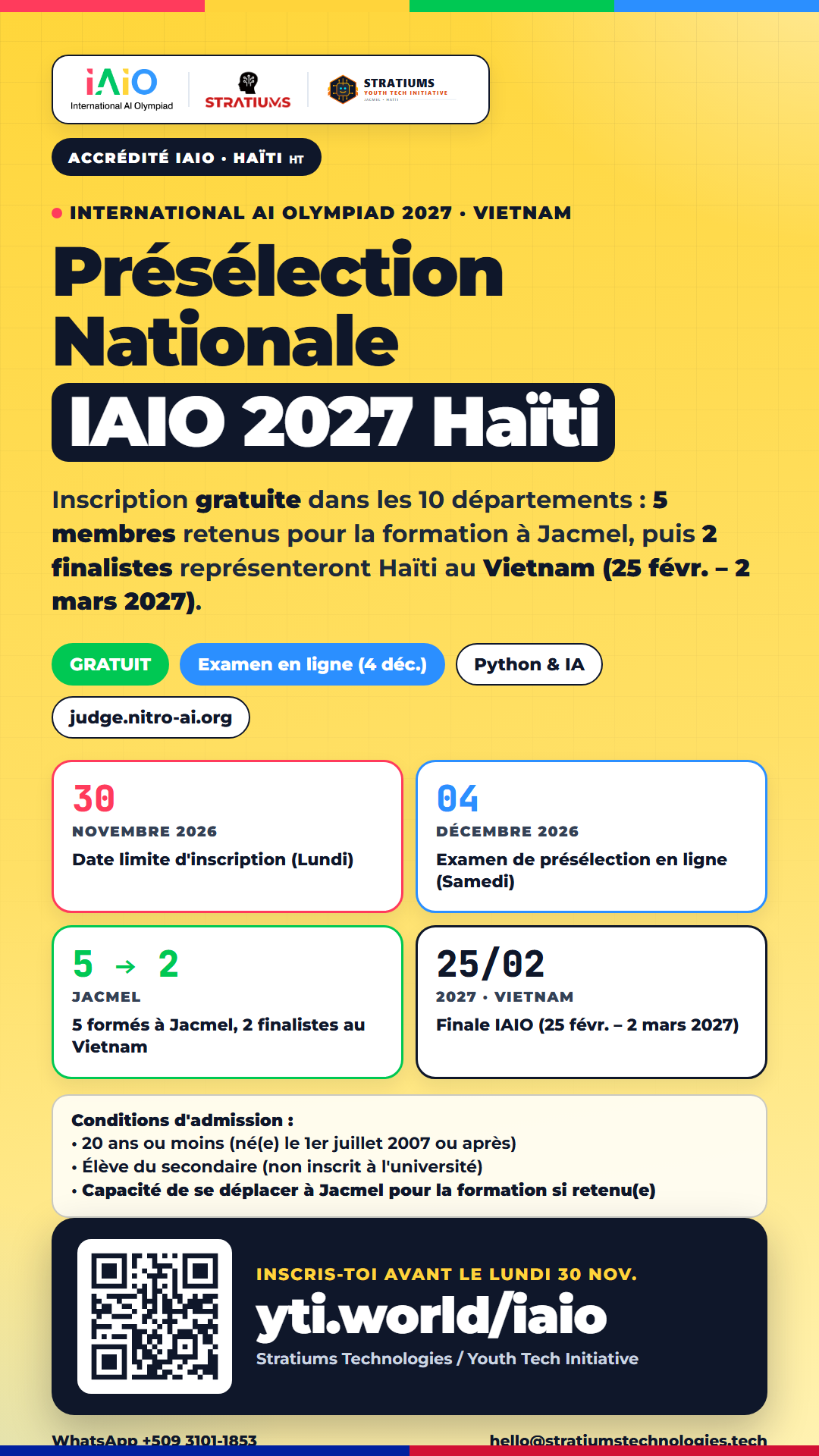
WhatsApp Status Flyer (9:16)
Download & share on WhatsApp Status
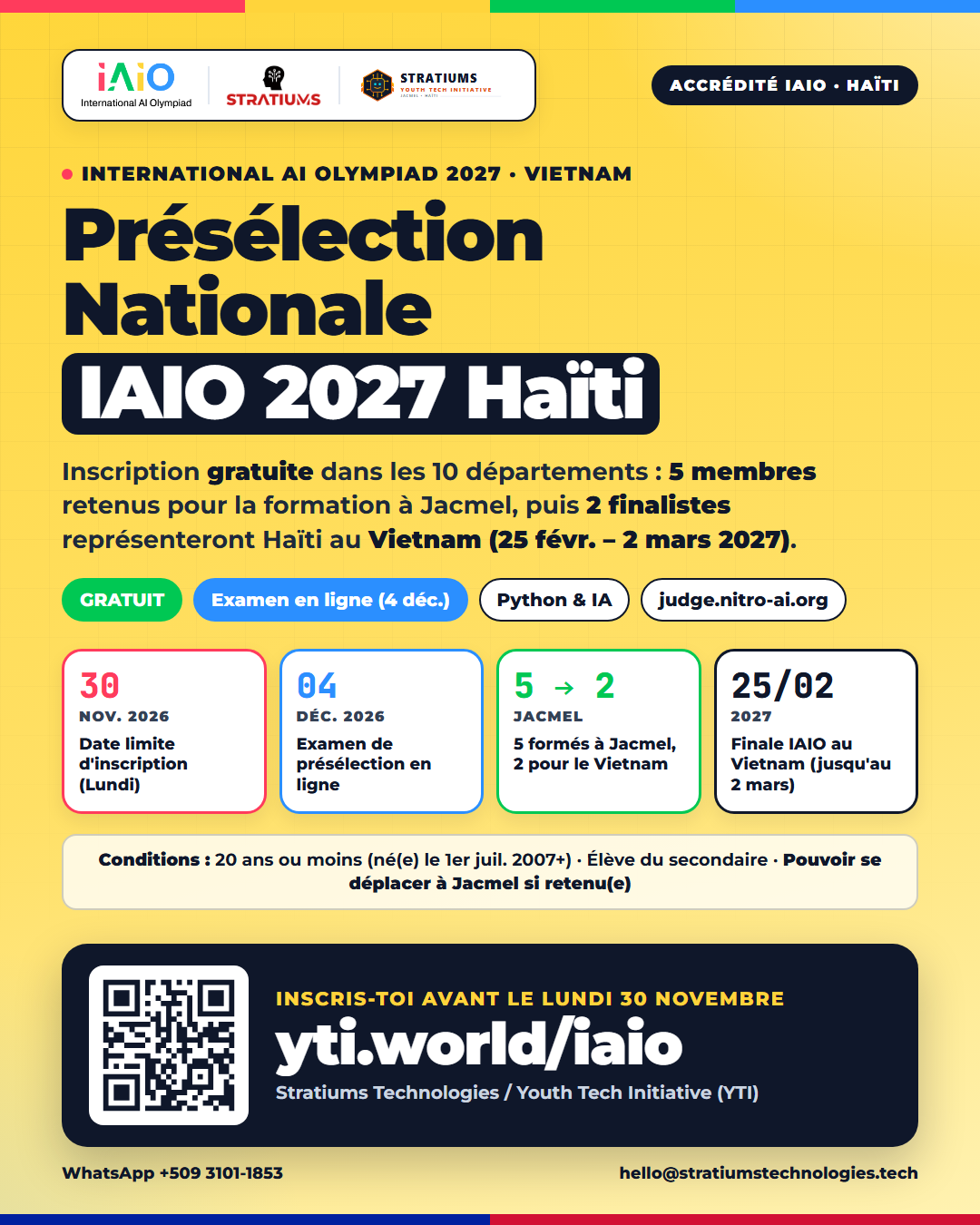
Facebook & WhatsApp Feed Flyer
Download & post on Facebook / WhatsApp groups
YTI Discord & Coaching
Python, ML & algorithms mentorship
Official IAIO Webinars & Lectures Archive
Per the IAIO syllabus, Theoretical Round questions are based only on the topics presented in these official IAIO webinars:
Interested in representing Haiti at IAIO 2027?
Contact Stratiums YTI or reach us at hello@stratiumstechnologies.tech.